
A GPU pipeline for a mobile 3D prostate-zone teaching library from public MRI
Nity G, Urology ST4 · built on Prostate158 (Adams et al. 2022, CC BY 4.0)
Problem
Trainees learn prostate zonal anatomy and lesion localisation from 2D MRI, which is hard to internalise spatially. Interactive 3D helps, but bespoke models are slow to make and too heavy for a phone at the bedside.
Approach
An automated, GPU-accelerated pipeline turns public Prostate158 MRI into a library of 100 mobile-optimised 3D zonal models (gland, peripheral and transition zones, lesion), each a single Draco-compressed GLB that loads on a mid-range phone and in AR.
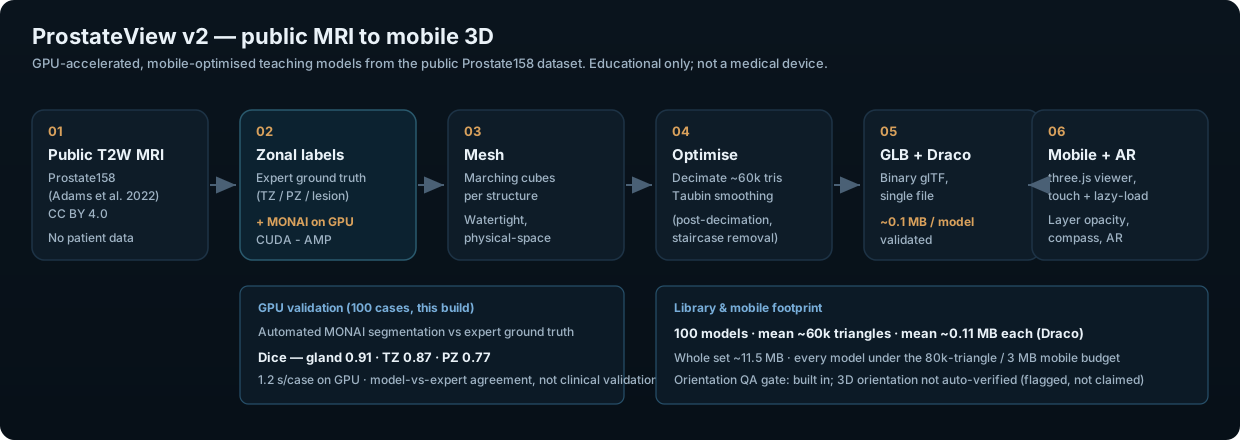
By the numbers
Technical validation
Automated MONAI Prostate158 segmentation vs the dataset's expert ground-truth labels, on the exact 100 cases shipped (CUDA, mixed precision). Model-vs-expert agreement — not a clinical validation.
| Structure | Dice (mean ± SD) |
|---|---|
| Whole gland | 0.91 ± 0.03 |
| Transition / central zone | 0.87 ± 0.05 |
| Peripheral zone | 0.77 ± 0.07 |
Device: GPU (CUDA, mixed precision) · n = 100. PZ is hardest, as expected.
Honest QA gate
The build runs an automated geometric orientation check (affine vs mesh centroid vs metadata) on every case. Of 102 candidates, 0 are auto-promoted to “orientation verified”: 88 inconclusive, 14 flagged for review.
The library is presented as orientation QA pending — the system flags what it cannot yet certify rather than overclaiming. Per-case left/right and base/apex review is the next step before any clinical-teaching promotion.
Try it on a phone
Scan to open the touch + AR-capable viewer. Each model lazy-loads only when its 3D view is opened.
What this is not
- Not a diagnostic tool and not a medical device.
- Does not assign PI-RADS, stage disease, or guide biopsy.
- Not clinically validated; 3D spatial orientation not yet verified per case.
- Built only from public, consented research data (Prostate158, CC BY 4.0).